
By: Jake Russell
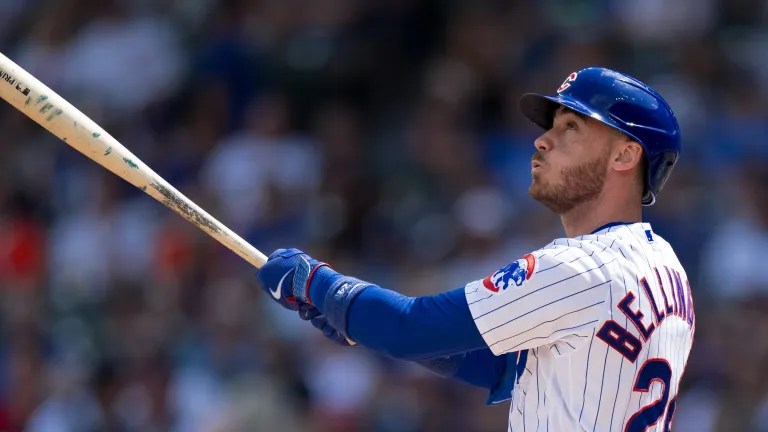
With Spring Training beginning to ramp up, the Chicago Cubs agreed to terms with Cody Bellinger to bring him back on a 3-year deal with opt-outs after each year. Bellinger will make 30 million dollars in 2024, can make another 30 million in 2025 if he opts in, and 20 million in 2026 if he once again opts in.
I honestly wasn’t sure if he was going to return to the Cubs. Still, it seems like the Cubs were the only real potential suitors (the only other team seriously mentioned were the Blue Jays, but they ended up resigning Kiermaier and it truly did seem like the Cubs were the only suitors. We may find out how true that is, but I’d be willing to bet Jed Hoyer was only negotiating against himself.
I want to briefly give my thoughts on the contract, but the point of this article is more to discuss and give my thoughts on how this affects the Cubs’ short and long-term outlooks.
If you know me you probably know I wasn’t a *huge* fan of giving Bellinger a long-term deal, and this contract certainly isn’t that. Whether people like it or not, there is a reason Bellinger waited this long, had so few suitors, and didn’t get that 200+ million dollar contract that he was reportedly seeking. Though Bellinger’s performance in 2023 was certainly real, there is cause for concern for regression in 2024. Mike Petriello wrote a very interesting article for MLB.com back in November detailing Bellinger’s free-agent case. The reality is that teams care about how Bellinger got to his 134 wRC+, and a profile with as weak of contact as Bellinger, and the poor swing divisions carries some risk–but I’m not here to rip on Bellinger, just food for thought.
Alas, Bellinger certainly did do several things well last year. He carried a 38% sweet-spot rate, a stat that measures the amount of balls hit at “ideal angles”, and has a pretty solid correlation with BABIP. That is, players who hit a higher amount of line drives tend to be able to carry higher BABIP numbers. That 38% was his highest figure since his MVP campaign in 2019, where he was quite frankly incredible. Bellinger also does a very good job of pulling fly balls. His 13.4% Pulled Fly-Ball rate last season ranked in the upper 12th percentile among hitters with more than 100 plate appearances. Why is that important? The corners in every MLB stadium are much shorter than straightaway centerfield, or even the alleys (and Wrigley’s alleys are relatively shorter compared to most MLB stadiums). Especially for players who don’t have as much raw power, pulling your fly balls can be key to “overperformance” (which isn’t overperformance if pulling fly balls is a skill).

It seems here like Bellinger really used his pull-side, and also used the gaps a lot (which the gaps at Wrigley are some of the shortest in baseball). You can really see a lot of fly balls out in the left-center gap, which could really benefit him if we assume he keeps hitting that way,
To further this, if we want to include spray angle in our analysis, PitcherList.com has a spray-adjusted xwOBA model, Bellinger’s xwOBA from 2023 jumps from a 53rd percentile value of .327, to… a 70th percentile value of .338! That is a somewhat significant jump, and in some cases, it can certainly be instrumental in explaining why a certain player accomplished what they accomplished–especially in Bellinger’s case.
Certainly, Bellinger could benefit by regaining a lot of that power he has lost over the past 3 seasons. Maybe a full 2 years removed from injury can help him to regain some of that. Even last season, he hit a ball 109.2 MPH, his hardest since 2020, though that still only fell in the 48th percentile of max EV.
It’s kind of weird to think about the contract this way, but Cubs fans should probably be rooting for Bellinger to opt out of the contract at the end of the year–because that means that he likely had a great year. His opting in likely means the opposite, so hopefully he will be very very good in 2024.
Obviously, this affects how the Cubs are going to construct their lineup this year. Bellinger played both Centerfield and First Base last season, and could very easily play both of those again this year. Being a plus defender at both positions certainly helps his case (even if first base defense doesn’t matter quite as much as other positions on the diamond). Currently, I would say the Cubs have 9 position player locks for the Opening Day Roster: Hoerner, Swanson, Happ, Bellinger, Suzuki, Morel, Busch, Gomes, and Amaya. With Morel seemingly being locked in as the Third Baseman now, that does open up the DH spot. I would think Tauchman is pretty likely to be on the roster, along with Patrick Wisdom and Nick Madrigal, which leaves just one spot for Mastrobuoni, Pete Crow-Armstrong, Matt Mervis, and Alexander Canario, all of whom saw playing time at the end of last season. Each one has a case to be on the OD roster this year. Let’s go over the case for each player.
Miles Mastrobuoni
Mastro is the epitome of a super-utility player. He played 5 different positions last season (not including DH and his inning on the mound), and even played a game in center field in the minors. That kind of player has value, especially as a bench player. Though his offense was a bit lackluster (he had just a 71 wRC+), Mastro is projected for a 96 wRC+ by Steamer, and regression to the mean is certainly plausible. It’s also worth noting he had 3 DRS across those 5 positions, which can be very valuable–and 3.6 BsR. A worthy bench player, but is having both him and Madrigal on the roster worth it?
OD Lineup with him:
C: Miguel Amaya
1B: Michael Busch
2B: Nico Hoerner
3B: Christopher Morel
SS: Dansby Swanson
LF: Ian Happ
CF: Cody Bellinger
RF: Seiya Suzuki
DH: Mike Tauchman
Certainly Madrigal could get a start at third and Morel could DH, but I am still running under the assumption that Morel will be the Opening Day third baseman.
Pete Crow-Armstrong
Arguably the person that this Bellinger signing affects most, PCA is definitely not a lock for the Opening-Day roster. He was poor in his 19 PA’s last season, but is undoubtedly the Cubs top prospect and probably the best defender in the minors. There’s still a path for him to be the opening-day centerfielder, with Bellinger playing first, but it’s certainly less certain than it was before.
OD Lineup with him:
C: Miguel Amaya
1B: Cody Bellinger
2B: Nico Hoerner
3B: Christopher Morel
SS: Dansby Swanson
LF: Ian Happ
CF Pete Crow-Armstrong
RF: Seiya Suzuki
DH: Michael Busch
If PCA is on the OD roster, he likely will start as much as possible. Tough to justify bringing up your top prospect and not playing him and, for what its worth, this is the situation I want the most. We’ll see if Jed Hoyer and Co agree.
Matt Mervis
Mervis exploded in the minors in 2022, but faltered in his brief Major League stint in 2023. There are certainly encouraging things from Mervis’s tenure: his power is absolutely off the charts, and he had a .434 xwOBACON with a 13.8 barrel%, but failed to get results really in any capacity. There is still hope, but with Busch coming to the Cubs and now Bellinger, it became a lot less likely.
OD Lineup with him:
C: Miguel Amaya
1B: Michael Busch
2B: Nico Hoerner
3B: Christopher Morel
SS: Dansby Swanson
LF: Ian Happ
CF: Cody Bellinger
RF: Seiya Suzuki
DH: Matt Mervis
In this scenario, Mervis gets the start against Nathan Eovaldi, who has good velocity but a rather below average pitch shape and fastball overall. Though once again you could argue Madrigal could get the start and play third base and Morel shifts over to DH, or Tauchman could DH like in the first scenario, this feels like my preferred outcome.
Alexander Canario
Canario was called up for most of the last month of the season, though didn’t see much playing time. He (like Mervis) has a lot of raw power, with a lot of swing and miss. Canario is not super athletic and it’s unsure if he can play center field, but he could be a solid right-handed bench bat–I guess it just depends on what the Cubs are looking for.
OD Lineup with him:
C: Miguel Amaya
1B: Michael Busch
2B: Nico Hoerner
3B: Christopher Morel
SS: Dansby Swanson
LF: Ian Happ
CF: Cody Bellinger
RF: Seiya Suzuki
DH: Mike Tauchman
This situation is also similar to several before. Tauchman gets the DH start, which is more than possible, with Canario on the bench. Again, Madrigal could play third. Wisdom could also get the DH start, or even Canario.
There is honestly just a world of possibilities with all the different roster combinations and lineup combinations the Cubs could have come opening day in Texas. The Cubs have such a great amount of depth and a great opportunity to be able to mix and match players for matchups. That’s probably the best part of the Bellinger signing (well maybe not, but it’s a rather huge benefit). The Cubs can be so flexible with so many players. It’s a complicated outlook–in a good way. I can probably think of like 100 different lineup combinations with these guys just based on versatility alone. As I said earlier, we’ll see what the Cubs decide to do in terms of roster construction.
Bellinger’s contract overall carries some risk, but it’s a pretty good deal for both sides. The Cubs get a guy who they hope can keep up what he did last year while being a fantastic clubhouse presence while adding tons of flexibility to the lineup.
Another aspect of this contract that I love is that it leaves the future pretty open for Cubs prospects. PCA is already MLB ready, while several batters (Matt Shaw, Owen Caissie, potentially Kevin Alcantara, and James Triantos) could be ready as soon as 2025. The possibilities are endless, and it still allows the Cubs to Let The Kids Play not only (hopefully, in the case of Pete Crow-Armstrong, in 2024), but beyond next year as well.





 Ivy League Cubs
Leave a comment